
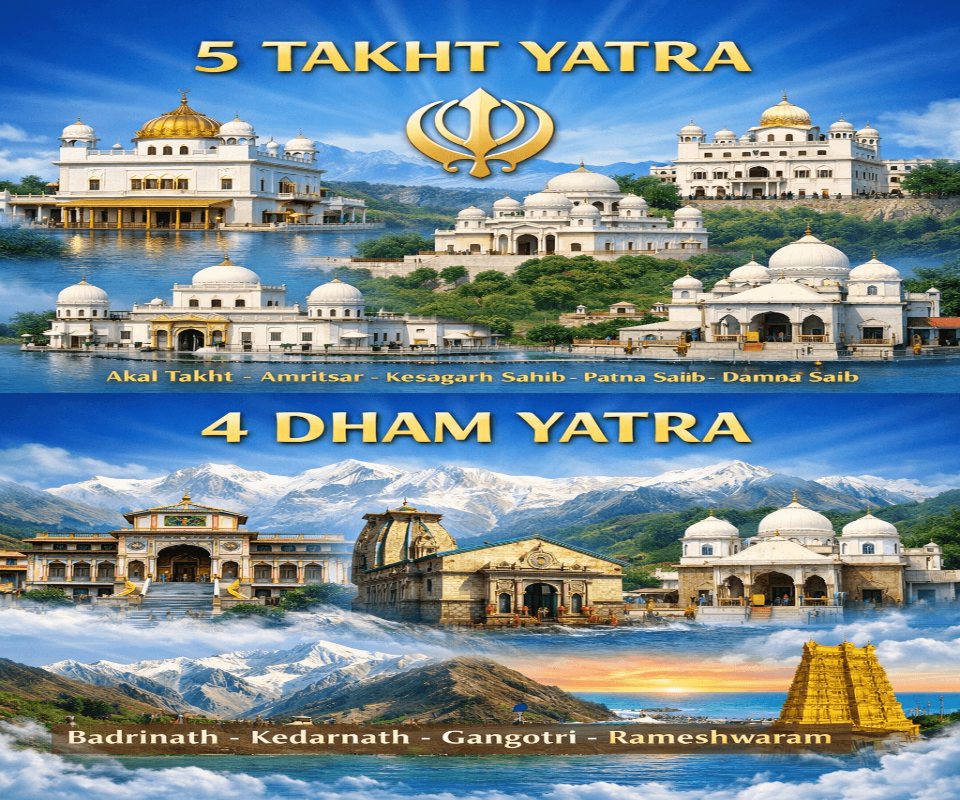
Sri Akal Takht Sahib (Amritsar)
Located within the Golden Temple complex, it is the highest temporal seat of Sikh authority, established by Guru Hargobind Ji in 1606.
Takht Sri Kesgarh Sahib (Anandpur Sahib)
The birthplace of the Khalsa Panth. Guru Gobind Singh Ji initiated the first five beloved ones (Panj Pyare) here in 1699.
Takht Sri Damdama Sahib (Talwandi Sabo)
Known as 'Guru Ki Kashi,' this is where Guru Gobind Singh Ji prepared the full version of the Sri Guru Granth Sahib.
Takht Sri Patna Sahib (Bihar)
The birthplace of the tenth Guru, Guru Gobind Singh Ji. It is a magnificent white marble structure on the banks of the Ganges.
Takht Sri Hazur Sahib (Nanded, Maharashtra)
The site where Guru Gobind Singh Ji spent his final days and passed the Gaddi (Guru-ship) to the Sri Guru Granth Sahib.
Sri Harmandir Sahib (Golden Temple)
The holiest shrine in Sikhism, symbolizing egalitarianism and peace. Its four doors signify a welcome to people from all walks of life.
Durgiana Temple (Amritsar)
Often called the "Silver Temple," it is dedicated to Goddess Durga and features architecture inspired by the Golden Temple.
Devi Talab Mandir (Jalandhar)
A historic Shakti Peeth dedicated to Goddess Kali, famous for its ancient pond and the annual Harballabh Sangeet Sammelan.
Fatehgarh Sahib
A site of immense historical sacrifice, commemorating the martyrdom of the younger sons of Guru Gobind Singh Ji.
Goindwal Sahib
Features the 'Baoli Sahib' with 84 steps; it was a major center for Sikhism during the time of the third Guru.
Tarn Taran Sahib
Founded by Guru Arjan Dev Ji, it boasts the largest sarovar (holy tank) among all Gurudwaras.
Gurudwara Ber Sahib (Sultanpur Lodhi)
Where Guru Nanak Dev Ji meditated for over 14 years and gained enlightenment.
Rauza Sharif (Sirhind)
An important Sufi shrine dedicated to Sheikh Ahmad Faruqi Sirhindi.
Darbar Sahib (Tuti Gandi)
Shaheed Ganj Sahib
Tibbi Sahib
Rakabsar Sahib
Tambu Sahib
Datansar Sahib
Mai Bhago Gurudwara
Mukte Minar + Memorial
🛕Punjab Spiritual Tour Route Plan
- Amritsar + Durgiana Temple + Akal Takht Spiritual Tour
- Anandpur Sahib + Fatehgarh Sahib + Goindwal Sahib Heritage Yatra
- Damdama Sahib + Muktsar Sahib + Nanaksar Religious Circuit
- Tarn Taran + Sultanpur Lodhi (Ber Sahib) + Rauza Sharif Sufi-Sikh Trail
- Hazur Sahib + Golden Temple + Five Takhts Global Darshan
- Jalandhar (Devi Talab) + Ramdaspur + Kapurthala Divine Yatra
Brahma Sarovar (Kurukshetra)
Considered one of Asia's largest man-made bathing tanks, it is dedicated to Lord Brahma. Mythology suggests Brahma created the universe from this spot. It is especially significant during Solar Eclipses, when hundreds of thousands gather to take a holy dip, believed to offer the fruit of a thousand Ashvamedha Yagnas.
Sannihit Sarovar (Kurukshetra)
Located nearby, this sarovar is believed to be the permanent abode of Lord Vishnu. Legend says that on the day of Amavasya (new moon), all sacred waters assemble here. It is the primary site for performing Shradh (rituals for ancestors).
Jyotisar (Kurukshetra)
This is arguably the most historically significant site in the region. It is the birthplace of the Bhagavad Gita. Under an ancient Banyan tree (Akshaya Vat), Lord Krishna delivered the Gita's discourse to Arjuna before the start of the Mahabharata war.
Mata Mansa Devi Temple (Panchkula)
Situated on the foothills of the Shivalik range, this temple is dedicated to Goddess Mansa Devi, a form of Shakti. It is a major center for pilgrimage during the Navratri festival and is known for its beautiful wall paintings (frescoes).
Sheetla Mata Mandir (Gurugram)
Dedicated to the wife of Guru Dronacharya (the teacher of the Pandavas and Kauravas), Mata Sheetla Devi is worshipped as the "Goddess of Pox." Millions of devotees visit to seek protection from diseases and for the "mundan" (first hair-cutting) ceremony of children.
Kali Mata Temple (Kalka)
Located at the gateway to the hills, this ancient temple dates back to the era of the Mahabharata. Legend says the Pandavas stayed here during their exile and worshipped the Goddess Kali for victory.
Bhuteshwar Temple (Jind)
Dedicated to Lord Shiva (Bhuteshwar), this temple was built by Raghubir Singh, a ruler of the Jind state. It sits in the middle of a large water tank, reminiscent of the Golden Temple’s layout.
Pehowa (Kurukshetra District)
Known as the "Gaya of Northern India," Pehowa is a vital pilgrimage site for ancestors' rituals (Pind Daan). It is situated on the banks of the ancient Saraswati River.
Kapil Muni Ashram (Kalayat, Kaithal)
Dedicated to the Vedic sage Kapil Muni, the founder of the Samkhya school of philosophy. The town "Kalayat" is a corruption of "Kapilayatana" (Home of Kapil). The site features unique brick temples from the Gurjara-Pratihara period.
Dhosi Hill Ashram (Mahendragarh)
An extinct volcano located on the border of Haryana and Rajasthan. It is the site of the Ashram of Rishi Chavan, the Vedic seer who formulated Chyawanprash. The hill is mentioned in the Brahmanas and the Mahabharata for its medicinal herbs.
Gita Bhavan (Kurukshetra)
Located on the banks of Brahma Sarovar, this is a modern spiritual center dedicated to the preservation and propagation of the Bhagavad Gita. It serves as a library, museum, and rest house for pilgrims.
🛕HaryanaSpiritual Tour Route Plan
- Kurukshetra + Brahma Sarovar + Jyotisar + Sannihit Sarovar Holy Dip
- Mata Mansa Devi + Sheetla Mata + Kali Mata Shakti Peeth Yatra
- Pehowa + Kapil Muni Ashram + Dhosi Hill Spiritual Trail
- Bhuteshwar Temple + Shiv Kund + Gita Bhavan Heritage Tour
Jwala Devi Temple (Kangra)
Famous for its "Eternal Flame." There is no idol; instead, natural gas flames emerge from the rocks, which have been burning for centuries.
Chintpurni Temple (Una)
Dedicated to Mata Chintpurni (the remover of worries). It is believed the feet of Sati fell here.
Naina Devi Temple (Bilaspur)
Situated atop a hill overlooking the Bhakra Dam. It marks the spot where Sati’s eyes (Naina) fell.
Brajeshwari Devi Temple (Kangra)
Located in Kangra Town, this temple is known for its grand structure and historical wealth, which famously drew the attention of invaders like Mahmud of Ghazni.
Chamunda Devi Temple (Kangra)
Situated on the banks of the Baner River, it is dedicated to the fierce form of Shakti. It is a popular spot for meditation and offers views of the Dhauladhar ranges.
Baijnath Temple (Kangra)
A stunning 13th-century Lord Shiva temple built in the Nagara style. It is believed that the "Jyotirlinga" here was placed by Ravana.
Hidimba Devi Temple (Manali)
An ancient wooden pagoda-style temple built in 1553. It is dedicated to Hidimba Devi, the wife of Bhima (from the Mahabharata), and is surrounded by a dense cedar forest.
Bijli Mahadev Temple (Kullu)
Known for its 60-foot-tall staff that attracts lightning (Bijli). Locals believe the lightning strikes the Shiva Lingam, breaking it into pieces, which the priest then rejoins using butter.
Jakhoo Temple (Shimla)
Located on the highest peak of Shimla, dedicated to Lord Hanuman. It features a massive 108-foot-tall statue of the deity visible from most parts of the city.
Tara Devi Temple (Shimla)
Perched on a hilltop with panoramic views of Shimla, dedicated to the Goddess of the Stars.
Rewalsar Lake (Mandi)
A unique sacred site shared by Hindus, Buddhists, and Sikhs. It is famous for its floating islands of reed and its deep connection to Guru Padmasambhava.
Kye Monastery
The largest monastery in Spiti Valley. It is a world-famous center for Buddhist learning and resembles a "fortress" perched on a conical hill.
Tabo Monastery
Known as the "Ajanta of the Himalayas," it was founded in 996 AD. It is a UNESCO World Heritage site containing ancient frescoes and stucco statues.
Manikaran Sahib (Kullu)
Located in the Parvati Valley, this is a major pilgrimage center for both Sikhs and Hindus. It is famous for its natural hot springs, where the water is hot enough to cook food.
Triloknath Temple (Lahaul)
Unique because it is sacred to both Hindus (who worship the deity as Lord Shiva) and Buddhists (who worship the deity as Avalokiteshvara).
🛕Himachal Pradesh Spiritual Tour Route Plan
- Jwala Devi + Chintpurni + Naina Devi + Brajeshwari + Chamunda 5 Devi Yatra
- Manikaran Sahib + Bijli Mahadev + Hidimba Devi Kullu Valley Tour
- Shimla + Tara Devi + Jakhoo Temple + Baijnath Spiritual Retreat
- Spiti Valley + Kye Monastery + Tabo + Triloknath Buddhist Circuit
- Rewalsar Lake + Mandi + Prashar Lake Sacred Journey
Vaishno Devi (Katra)
One of the most visited pilgrimage sites in India, located in the Trikuta Mountains.
Significance: Dedicated to Shakti, the cave temple is reached via a 12-14 km trek from Katra.
Unique Feature: The goddess is worshipped in the form of three natural rock formations known as Pindis, representing Maha Kali, Maha Lakshmi, and Maha Saraswati.
Raghunath Temple (Jammu City)
Significance: Built primarily by Maharaja Gulab Singh and finished by his son Ranbir Singh in the mid-19th century.
Unique Feature: The complex consists of seven shrines, each with its own Shikhara (spire). The interior walls of the main temple are covered in gold sheets on three sides.
Ranbireshwar Temple (Jammu City)
Significance: Dedicated to Lord Shiva and built by Maharaja Ranbir Singh in 1883.
Unique Feature: It is famous for housing twelve crystal Shiva Lingams and one massive central stone Lingam that is nearly eight feet high.
Sudh Mahadev Temple (Chenani)
Significance: An ancient temple located near Patnitop, believed to be over 2,800 years old. Unique Feature: It houses a broken iron trident (Trishul) which, according to legend, belonged to Lord Shiva.
Peer Kho Cave Temple (Jammu City)
Significance: Located on the banks of the Tawi River, it is one of the oldest Shiva temples in the region.
Unique Feature: It is a natural cave formation. Legend says the famous character Jamwant (from the Ramayana) meditated here.
Amarnath Cave (Pahalgam/Sonamarg)
Significance: Located at an altitude of 3,888 meters, it is accessible only during the summer months.
Unique Feature: It is famous for the natural ice stalagmite (Ice Lingam) that waxes and wanes with the phases of the moon.
Shankaracharya Temple (Srinagar)
Significance: Perched on top of the Gopadari Hill, it offers a panoramic view of Srinagar and Dal Lake.
Unique Feature: It is one of the oldest shrines in Kashmir, dating back to 200 BC, though the current structure was likely rebuilt later.
Kheer Bhawani Temple (Tulmulla)
Significance: Dedicated to the Goddess Maharagya Devi.
Unique Feature: The temple is built over a sacred spring. It is traditionally believed that the color of the spring water changes to warn of upcoming local events or disasters.
Charar-e-Sharif (Budgam)
Significance: A 600-year-old shrine dedicated to the Sufi saint Sheikh Noor-ud-din Wali (Nund Rishi).
Unique Feature: It is a symbol of the "Rishi" tradition and Kashmiri communal harmony.
Sharika Devi Temple (Srinagar)
Significance: Located on Hari Parbat hill, it is dedicated to Goddess Sharika, an 18-armed form of Durga.
Unique Feature: The goddess is worshipped as a Swayambhu (self-manifested) figure on a Srichakra at a large rock.
Martand Sun Temple (Anantnag)
Significance: An 8th-century Hindu temple built by King Lalitaditya Muktapida.
Unique Feature: Though now in ruins, it is a masterpiece of Kashmiri architecture, blending Greek, Roman, and Indian styles. It was dedicated to Surya, the Sun God.
🛕Jammu & Kashmir Spiritual Tour Route Plan
- Katra + Vaishno Devi + Shiv Khori + Sudh Mahadev Yatra
- Srinagar + Shankaracharya + Hazratbal + Kheer Bhawani City Tour
- Amarnath Cave + Martand Sun Temple + Peer Kho Cave Pilgrimage
- Jammu + Raghunath Temple + Ranbireshwar + Charar-e-Sharif Heritage Trail
Kedarnath Temple
One of the 12 Jyotirlingas and part of Panch Kedar, this Shiva temple at 3,583 meters was built by Adi Shankaracharya in the 8th century, though linked to Pandavas in mythology; it's near the Mandakini River. Pilgrims visit May-June when open, enduring treks amid stunning peaks
Badrinath Temple
Dedicated to Vishnu as Badrinarayan, revived by Adi Shankaracharya in the 8th century with a black stone idol; located in Chamoli at high altitude. It's the northernmost Char Dham site, rebuilt after earthquakes like 1803.
Gangotri
Source of Ganga (Bhagirathi River), the 18th-century temple built by Gorkha commander Amar Singh Thapa sits at 3,042 meters. Mythology ties it to King Bhagirath's penance to bring Ganga to earth.
Yamunotri
Origin of Yamuna River at 3,293 meters, temple built in the 19th century by Tehri Garhwal's Maharaja Pratap Shah with a black marble Yamuna idol. Devotees bathe in sacred hot springs and seek blessings from the river goddess, sister of Yama.
Haridwar
Known as "Gateway to Gods," sanctified by Ganga's descent via Bhagirath; Har Ki Pauri features Vishnu's footprint. Major Kumbh Mela site where pilgrims dip for salvation.
Rishikesh
Yoga's birthplace where Shiva taught Parvati; Ganges flows through ashrams and bridges. Spiritual hub for meditation, adventure, and Beatles-inspired vibes.
Panch Kedar Temples
These five Shiva shrines commemorate parts of a bull form he escaped Pandavas in; visited sequentially for blessings.
Tungnath Temple
Highest Shiva temple at 3,680 meters, over 1,000 years old as third Panch Kedar. Short trek from Chopta offers panoramic views.
Kalpeshwar Temple
Fifth Panch Kedar in Urgam Valley; site of sages' penance and Urvashi's creation by Durvasa. Open year-round due to milder climate.
Rudranath Temple
Fourth Panch Kedar at 3,600 meters in Chamoli, worships Shiva's face. Toughest trek, embodying Shiva's wild nature.
Madhyamaheshwar Temple
Second Panch Kedar for Shiva's navel/belly; promises sin removal. Set amid Garhwal meadows at high altitude.
Dhari Devi Temple
Guardian Kali of Char Dham on Alaknanda River; idol's face changes thrice daily, established after flood legend. En route Srinagar-Rudraprayag, no photography inside.
Patal Bhuvaneshwar
Mystical cave temple; King Rituparna discovered gods' statues via Sheshnag, later expanded by kings. Features stalactites as deities, narrow entry.
Jageshwar Dham
Ancient Shiva temple complex in Almora, ~2,500 years old with Katyuri architecture and 1st-century BC pillar. Over 100 shrines in deodar forests for serene worship.
🛕Uttarakhand Spiritual Tour Route Plan
- Yamunotri + Gangotri + Kedarnath + Badrinath Chardham Yatra
- Haridwar + Rishikesh + Neelkanth Mahadev Ganga Aarti Tour
- Hemkund Sahib + Joshimath + Dhari Devi Himalayan Journey
- Panch Kedar + Tungnath + Jageshwar Dham + Patal Bhuvaneshwar Trek
Mahabodhi Temple
Built by Emperor Ashoka around 260 BCE, this 55-meter brick pyramid marks Buddha's enlightenment; it's a UNESCO site restored multiple times, including in the 19th century.
Vishnupad Temple
Houses Vishnu's 40 cm footprint on rock, linked to subduing demon Gayasur; 30-meter pavilion with carved pillars for pind daan rituals.
Mangla Gauri Temple
15th-century Shakta Pitha dedicated to Goddess Sati, one of 18 major ones mentioned in Puranas.
Bodhi Tree
Sacred peepul tree under which Siddhartha Gautama attained enlightenment circa 589 BCE; Ashoka established a monastery here in 250 BCE.
Nalanda
Ancient university ruins, a major Buddhist center destroyed in 1202 CE by Bakhtiyar Khalji; excavated in the 19th century, it hosted scholars for centuries.
Rajgir
Ancient city with walls from King Ajatashatru's era; key Buddhist sites include Bimbisar's Jail and Jain temples on hill peaks.
Griddhakuta Hill
Known as Vulture's Peak, a meditation site for Buddha where he delivered key sermons.
Venu Vana (Rajgir)
Bamboo Grove monastery donated to Buddha by King Bimbisara.
Patna Sahib Gurudwara
Birthplace of Guru Gobind Singh (1666); rebuilt by Maharaja Ranjit Singh, damaged by fire (1839) and quake (1934), now a Takht with museum.
Patna Sahib Gurudwara
Birthplace of Guru Gobind Singh (1666); rebuilt by Maharaja Ranjit Singh, damaged by fire (1839) and quake (1934), now a Takht with museum.
Mahavir Mandir
Multi-sanctum temple with Rama-Shabri, Krishna-Arjuna, Durga; features Rudrabhishek in Shravana month.
Agam Kuan
Mauryan-era (3rd century BCE) deep well attributed to Ashoka, legendarily used for executions; name means "unfathomable well.
Jal Mandir
White marble temple in lotus pond marking Lord Mahavira's moksha (liberation) and cremation site.
Kesaria Stupa
World's largest stupa at 104 feet tall, built in 3rd century BCE under Ashoka, expanded in Gupta era (200-750 CE)
Valmiki Ashram
Sage Valmiki's hermitage on India-Nepal border; features Sita temple and Sita Rasoi where she ground spices.
Buxar Ramrekha Ghat
Ganga site where Rama bathed post-Tadka killing to atone; linked to his first battle in Tadaka Van.
Hariharnath Temple
Built by Rama en route to Sita's swayamvar; site for puja during Sonepur Mela at Ganga-Gandak confluence.
Mundeshwari Temple
Among India's oldest functional temples (circa 2,000 years), dedicated to Goddess Mundeshwari atop Mundeshwari Hills.
Sitamarhi Janaki Temple
Believed as Sita's birthplace from Ramayana; modern structure near Janaki Kund, crowded during Navratri and Ram Navmi.
Ahilya Asthan
Temple dedicated to Ahalya in Kamtaul, linked to her story in Hindu mythology.
Thai Monastery
Built 1956 via India-Thailand ties; unique Thai architecture, first such temple in India for serene meditation.
🛕Bihar Spiritual Tour Route Plan
- Bodh Gaya + Mahabodhi + Nalanda + Rajgir Buddhist Heritage
- Patna Sahib + Mahavir Mandir + Agam Kuan City Darshan
- Gaya + Vishnupad Temple + Mangla Gauri + Buxar Spiritual Yatra
- Sitamarhi + Ahilya Asthan + Janaki Temple Ramayana Trail
- Pawapuri + Jal Mandir + Kesaria Stupa + Hariharnath Mela Tour
Trimbakeshwar Temple
Unique because the linga has three faces representing Brahma, Vishnu, and Mahesh. It is the source of the Godavari River.
Bhimashankar Temple
Located in a lush wildlife sanctuary, this temple is associated with the legend of Shiva defeating the demon Tripurasura.
Grishneshwar Temple
Located near the Ellora Caves, it is believed to be the last Jyotirlinga. It was reconstructed by Ahilyabai Holkar.
Parli Vaijnath Temple
Known for its medicinal atmosphere; it is said that the touch of the linga has healing powers.
Aundha Nagnath
(Note: Often visited alongside Parli as part of the Jyotirlinga circuit).
Shirdi Sai Baba Temple
The shrine of the 19th-century saint Sai Baba, who preached "Sabka Malik Ek" (One God governs all). It is one of the most visited pilgrimage sites in India.
Siddhivinayak Temple
Dedicated to Lord Ganesha, this temple is famous for its "Navasacha Ganpati," or the Ganesha who grants every wish.
Pandharpur Vitthal Temple:
The center of the Warkari tradition. Devotees (Warkaris) trek hundreds of miles on foot during Ashadhi Ekadashi to see Lord Vitthal and Rukmini.
Shani Shingnapur
Famous for being a village where houses have no doors, as residents believe Lord Shani protects them from theft.
Tulja Bhavani Temple
The family deity of Chhatrapati Shivaji Maharaj. It is one of the 51 Shakti Peethas.
Mahalakshmi Temple
An architectural marvel where, during the "Kiranotsav" festival, the sun’s rays fall directly on the deity’s feet.
Saptashrungi Temple
Situated on a cliff with seven peaks, the idol of the Goddess is nearly 8 feet tall and carved into the rock.
Harihareshwar Temple
Known as "Dakshin Kashi," it is surrounded by four hills representing Shiva, Vishnu, Brahma, and Parvati.
Parli Vaijnath Temple
Known for its medicinal atmosphere; it is said that the touch of the linga has healing powers.
Nanded Hazur Sahib
One of the five Takhts (seats of authority) in Sikhism. It marks the place where Guru Gobind Singh Ji, the tenth Guru, passed away.
Ajanta & Ellora Caves
UNESCO World Heritage sites. Ajanta is famous for its Buddhist paintings and frescoes, while Ellora features 34 monasteries and temples, including the monolithic Kailasa Temple carved from a single rock.
Global Vipassana Pagoda
A massive meditation hall built without supporting pillars, containing bone relics of the Buddha.
Mount Mary Church
A beautiful Roman Catholic Basilica. Thousands of people of all faiths visit during the "Bandra Fair" in September.
🛕Maharashtra Spiritual Tour Route Plan
- Shirdi + Shani Shingnapur + Trimbakeshwar + Bhimashankar Yatra
- Mumbai + Siddhivinayak + Mahalakshmi + Global Pagoda City Tour
- Nanded Hazur Sahib + Grishneshwar + Ajanta Ellora Heritage
- Pandharpur + Tulja Bhavani + Kolhapur Mahalakshmi Shakti Path
- Ashtavinayak + Jejuri + Ekvira Devi + Saptashrungi Devi Darshan
Mahakaleshwar Jyotirlinga
One of the 12 Jyotirlingas, this is the only one that is Dakshinmukhi (south-facing). It is world-famous for the Bhasma Aarti, where the deity is worshipped with sacred ash. The temple sits on the banks of the Shipra River and is a core site for the Kumbh Mela.
Omkareshwar Temple
Located on an island called Mandhata, the island is naturally shaped like the sacred symbol "Om." It is another of the 12 Jyotirlingas. Pilgrims often perform a Parikrama (circumambulation) of the island to pay their respects.
Mamleshwar Temple
Located just across the river from Omkareshwar, many devotees believe that the Jyotirlinga is split between these two temples. A visit to Omkareshwar is considered incomplete without offering prayers at Mamleshwar.
Kal Bhairav Temple
Known as the "Guardian of Ujjain," this temple has a unique tradition where liquor is offered to the deity as Prasad. It follows the Tantric tradition and is a must-visit for those seeking protection and discipline.
Harsiddhi Temple
This is one of the 51 Shakti Peethas. It is said that the elbow of Goddess Sati fell here. The temple is famous for its two massive 15-foot lamp towers (Deep Stambhas) which, when lit during Navratri, create a breathtaking sight.
Chintaman Ganesh Temple
Dating back to the 11th century, this temple houses an idol of Lord Ganesha that is believed to be Swayambhu (self-manifested). As the name suggests, "Chintaman" means "the reliever of worries."
Sanchi Stupa
A UNESCO World Heritage site, this is one of the oldest stone structures in India. Commissioned by Emperor Ashoka in the 3rd century BCE, it is a pinnacle of Buddhist architecture, famous for its intricate gateways (Toranas) depicting the life of Buddha.
Udayagiri Caves
A collection of 20 rock-cut caves from the early 5th century (Gupta Period). Cave 5 is the most iconic, featuring a massive, masterful carving of Lord Vishnu in his Varaha (Boar) incarnation rescuing the Earth.
Bhojpur Shiva Temple
Founded by King Bhoja, this temple houses one of the tallest Shiva Lingas in India, carved out of a single rock. Though the temple remains unfinished, its massive stone pillars and architectural plan are a marvel of medieval engineering.
Pitambara Peeth
A major center for Shaktism, this ashram is dedicated to Bagalamukhi Devi. It is a highly powerful "Siddha Peetha" where politicians and seekers alike flock to seek the Goddess’s blessings for victory and protection.
Orchha Ram Raja Temple
The only temple in India where Lord Rama is worshipped as a King rather than a God. He is given a guard of honor by the police every day. The architecture is that of a palace rather than a traditional temple.
Chitrakoot
A sacred town where Lord Rama, Sita, and Lakshmana are believed to have spent 11 of their 14 years in exile. Key spots include Ram Ghat and the Kamadgiri hill, which devotees circumambulate.
Maihar Devi Temple
Dedicated to Maa Sharda, this temple sits atop the Trikuta Hill. You have to climb 1,063 steps (or take the ropeway) to reach it. It is famously associated with the legendary warrior brothers Alha and Udal.
Amarkantak
The meeting point of the Vindhya and Satpura ranges, this is the source of the Narmada and Son rivers. It is known as "Teerthraj" (The King of Pilgrimages) and is a lush, serene spot for meditation.
Barman Ghat
A beautiful stretch on the banks of the Narmada. It is particularly famous for the Deep Daan during Makar Sankranti. It houses several ancient temples and is a peaceful spot for a holy dip.
Jatashankar Temple
Located inside a natural limestone cave, the stalactites here look like the matted hair (Jata) of Lord Shiva. It’s a stunning example of nature creating its own shrine.
Gupt Godavari
A pair of caves where a stream of water (the "Secret Godavari") flows. You can walk through the knee-deep water inside the caves, ending at a spot where the river mysteriously disappears into the rocks.
Dada Darbar
A spiritual site dedicated to the 19th-century saint Dadaji Dhuniwale. It is a place of deep faith where a sacred fire (Dhuni) has been kept burning continuously for over a century.
Bawangaja Jain Temple
Home to an awe-inspiring 84-foot tall statue of Lord Adinatha (the first Tirthankara), carved directly into the mountain rock. It is a major pilgrimage site for the Jain community.
Gopal Mandir
A beautiful example of Maratha architecture, this temple is dedicated to Lord Krishna. The silver-plated doors of the inner sanctum have a fascinating history, allegedly having been stolen by Ghazni and later recovered.
🛕 Madhya Pradesh Spiritual Tour Route Plan
- Ujjain + Mahakaleshwar + Omkareshwar + Mamleshwar Jyotirlinga Yatra
- Sanchi Stupa + Bhojpur + Udayagiri Caves Buddhist & Shiva Trail
- Orchha + Pitambara Peeth + Chitrakoot + Maihar Devi Shakti Yatra
- Amarkantak + Barman Ghat + Narmada River Source Pilgrimage
- Indore + Khajrana + Gwalior + Dada Darbar Spiritual Circuit
Akshardham Temple
One of the largest Hindu temple complexes in the world, located in East Delhi along the Yamuna.Dedicated to Bhagwan Swaminarayan; showcases traditional stone‑carved architecture, intricate sculptures, and features exhibitions on Indian culture, values, and history.Open to visitors of all faiths; entry is free but special heritage shows and the boat ride through Indian history attract a nominal fee.
Lotus Temple
Also known as the Baháʼí House of Worship in Delhi, located in Kalkaji. Designed in the form of a lotus flower with 27 marble petals arranged in clusters of three, surrounded by nine pools of water. Open to all religions; no rituals or sermons are held—only calm prayer and silent meditation are allowed inside.
Kalkaji Temple
Ancient Hindu temple in South Delhi dedicated to Goddess Kali (Kalka), located in the Kalkaji locality. Believed to be over 3,000 years old in legend; the current structure largely dates from the 18th century (around 1764 AD), built by the Marathas. Very popular during Navratri and Diwali; the locality and the nearest metro station are named after this temple.
Gurudwara Bangla Sahib
One of the most prominent Sikh gurdwaras in Delhi, near Connaught Place. Associated with the eighth Sikh Guru, Guru Har Krishan; includes a sacred water tank (Sarovar) believed to have healing properties. Known for its 24‑hour community kitchen (langar) where free meals are served to all, regardless of background.
Gurudwara Sis Ganj Sahib
Located in Chandni Chowk, Old Delhi, this gurdwara marks the site where Guru Tegh Bahadur, the ninth Sikh Guru, was publicly executed in 1675. It stands as a place of remembrance and martyrdom; the building is prominent among the nine historic gurdwaras reconstructed in Delhi by Sardar Baghel Singh. The sanctum houses the Guru Granth Sahib and offers daily prayers and langar.
Gurudwara Rakab Ganj Sahib
Situated near Parliament House and Connaught Place, this gurdwara commemorates the cremation of Guru Tegh Bahadur after his execution. It is one of the nine major historic Sikh shrines in Delhi, built by Sardar Baghel Singh in 1783. The complex includes a large hall for congregations, a community kitchen, and the sacred tank (Sarovar).
Nizamuddin Dargah
The Sufi shrine (dargah) of the 13th‑century saint Hazrat Nizamuddin Auliya, located in Nizamuddin West, South Delhi. Famous for its qawwali sessions, especially on Thursday evenings, which attract large crowds of devotees and music lovers. The complex also houses the tombs of poet Amir Khusrau and other revered figures, making it a major spiritual and cultural hub.
Jama Masjid
One of the largest mosques in India, built by Mughal Emperor Shah Jahan in the 17th century (1650–1656) in Old Delhi. Located opposite the Red Fort in Chandni Chowk; can accommodate thousands of worshippers and has three grand gateways and two tall minarets. Offers a panoramic view of Old Delhi from its courtyard; especially crowded during Eid prayers.
Laxminarayan Temple
A prominent Hindu temple in central Delhi, built by the Birla family and inaugurated by Mahatma Gandhi in 1939. Dedicated to Lord Vishnu (as Laxminarayan) and Goddess Lakshmi, with additional shrines to other deities such as Shiva, Hanuman, and Buddha. Known for its peaceful atmosphere, architectural blend of traditional and modern styles, and its location near Connaught Place.
Hanuman Mandir, Connaught Place
A small but very famous Hanuman temple located in the inner circle of Connaught Place, visited by locals and tourists alike. Considered auspicious for offering prayers before starting new ventures or exams; devotees often tie red threads as a form of wish‑fulfillment ritual. Usually crowded in the morning and evening; the temple is under the care of the Delhi Development Authority.
Chhatarpur Temple
A large Hindu temple complex in South Delhi, dedicated mainly to Goddess Katyayani (a form of Durga). Set in a spacious garden‑like environment with multiple shrines for various deities, including Shiva, Ganesh, Hanuman, and others. Popular for Saturday and Sunday visits, especially on full‑moon days and during Navratri
Sai Baba Temple, Lodhi Road
A well‑known temple dedicated to Shirdi Sai Baba, located on Lodhi Road in central Delhi. Attracts devotees of all ages who come for daily darshan, aarti, and to participate in bhajans and community prayers. Known for its simple yet serene atmosphere and regular free food distribution (prasad and langar‑style meals).
ISKCON Temple, Delhi
The Hare Krishna temple in East of Kailash, South Delhi, belonging to the International Society for Krishna Consciousness. Houses a grand marble temple dedicated to Radha–Krishna along with a large complex featuring a museum, restaurant, and cultural activities. Offers daily aarti, bhajans, prasadam, and weekend spiritual discourses, making it popular among visitors of all ages.
Yogmaya Temple
An ancient Hindu temple located at the Mehrauli–Qutub complex area, believed to be one of the oldest surviving temples in Delhi. Dedicated to Yogmaya, a form of the goddess associated with the Mahabharata era; it is said to be the sister of Lord Krishna. Typically visited by devotees during festivals like Navratri and Diwali; the temple is surrounded by historical monuments including the Qutub complex.
Sacred Heart Cathedral
The principal Catholic church and cathedral of the Archdiocese of Delhi, located in New Delhi. Built in typical Gothic‑style architecture with a large dome and stained‑glass windows; it serves as the seat of the Archbishop of Delhi. The cathedral hosts regular Masses, special liturgical services, and important religious events such as Christmas and Easter.
🛕Delhi Spiritual Tour Route Plan
- Akshardham + Lotus Temple + ISKCON Modern Temple Tour
- Bangla Sahib + Sis Ganj + Rakab Ganj Gurudwara Darshan
- Nizamuddin Dargah + Jama Masjid + Sacred Heart Cathedral Heritage Walk
- Kalkaji + Chhatarpur + Yogmaya + Birla Mandir Devi Yatra
Kashi Vishwanath Temple
Located on the western bank of the Ganga, this is one of the twelve Jyotirlingas. The current structure was built by Ahilyabai Holkar in 1780. Its gold-plated spires and the narrow "Vishwanath Gali" offer one of the most intense spiritual atmospheres in India.
Ganga Ghats
Varanasi has about 84 ghats. Key ones include:
Dashashwamedh Ghat: Famous for the spectacular evening Ganga Aarti.
Manikarnika & Harishchandra Ghats: The primary cremation grounds where life and death meet.
Assi Ghat: Popular for morning prayers (Subah-e-Banaras).
Ganga Ghats
Varanasi has about 84 ghats. Key ones include:
Dashashwamedh Ghat: Famous for the spectacular evening Ganga Aarti.
Manikarnika & Harishchandra Ghats: The primary cremation grounds where life and death meet.
Assi Ghat: Popular for morning prayers (Subah-e-Banaras).
Ayodhya Ram Mandir
A masterpiece of Maru-Gurjara architecture, this newly inaugurated temple marks the birthplace of Lord Rama. It is built entirely of pink sandstone without the use of iron or steel, symbolizing eternal strength.
Hanuman Garhi
A 10th-century cave temple situated on a hillock. Tradition holds that one must visit Hanuman Garhi to seek permission from Lord Hanuman before visiting the Ram Temple.
Krishna Janmabhoomi (Mathura)
The prison cell (Garbha Griha) where Lord Krishna was born. The complex is a blend of deep history and high security, neighboring the Shahi Idgah Mosque.
Banke Bihari Temple (Vrindavan)
Perhaps the most popular temple in Vrindavan. The deity’s eyes are kept behind a curtain that is opened and closed every few minutes to prevent visitors from being overwhelmed by the Lord's "divine gaze."
Prem Mandir
Managed by Jagadguru Kripalu Parishat, this temple is made of Italian white carrara marble. It is famous for its stunning LED light displays at night and intricate carvings depicting Krishna’s leelas.
ISKCON Vrindavan
The first ISKCON temple in India. It is known for its cleanliness, the high energy of its kirtans, and the white marble tombs of Swami Prabhupada.
Barsana Radha Rani Temple
Perched on the Bhanugarh hill, this is the birthplace of Radha. It is the epicenter of the world-famous Lathmar Holi.
Nandgaon Temple
Located on the Nandishwar hill, this was the home of Lord Krishna’s foster father, Nanda Baba. It serves as the counterpart to Barsana during the Holi festivities.
Triveni Sangam
The holy confluence of three rivers: the Ganges, the Yamuna, and the mythical Saraswati. It is the primary site for the Kumbh Mela, where a dip is believed to wash away all sins.
Vindhyachal Temple
Located near Mirzapur, this is a major Shakti Peeth dedicated to Goddess Vindhyavasini. It is uniquely situated at the point where the Vindhya Range meets the Ganges.
Deva Sharif Dargah
The shrine of Sufi Saint Waris Ali Shah. It is a symbol of communal harmony, famous for the message "Jo Rab Hai, Wohi Ram Hai" (Who is God, is also Ram).
Dudheshwar Nath Temple
An ancient Shiva temple where the lingam is said to be self-manifested (Swayambhu). It is one of the most significant sites for devotees in the National Capital Region.
Kalyan Devi Temple
An ancient temple dedicated to Goddess Kalyan Devi, believed to be over 1,500 years old. It is part of the sacred Shakti circuit of Prayagraj.
Shri Sankat Mochan Hanuman Temple
Established by Goswami Tulsidas, this temple is unique because the idol of Hanuman faces his Lord, Rama. It is a hub for monkeys and spiritual seekers alike.
Tulsi Manas Mandir
Built at the spot where Tulsidas wrote the Ramcharitmanas. The walls are engraved with verses from the epic, providing a visual narration of Rama’s life.
Chitrakoot Dham
The "Hill of Many Wonders." This is where Rama, Sita, and Laxman spent 11 of their 14 years in exile. Key sites include Ramghat and Bharat Milap Temple.
Govardhan Hill
A 21 km sacred hill that Krishna is said to have lifted on his pinky finger. Devotees perform Parikrama (circumambulation) around it as an act of worship.
Bateshwar Temples
Located near Agra on the banks of the Yamuna, this site features a complex of over 100 Shiva temples. It is also famous for its annual livestock fair, one of the largest in India.
🛕Uttar Pradesh Spiritual Tour Route Plan
- Varanasi + Ayodhya + Prayagraj Tour
- Shirdi + Trimbakeshwar + Bhimashankar
- Ujjain + Omkareshwar Jyotirlinga Yatra
- Bodh Gaya + Rajgir + Nalanda Buddhist Circuit
- Delhi Multi-Religion Spiritual Tour
Khatu Shyam Ji Temple
Dedicated to Barbarika (the grandson of Bhima), who is worshipped as Lord Krishna’s manifestation. Devotees believe that rubbing the dust of this "Sheesham Ke Daani" (Donor of the Head) brings immense luck.
Salasar Balaji Temple
Unique because the idol of Hanuman ji here features a beard and mustache. It is a major site for "Sawa-mani" offerings (50kg of food offered to the deity).
Mehandipur Balaji Temple
Renowned globally for spiritual healing and the exorcism of evil spirits. It is dedicated to the fierce aspect of Hanuman.
Karni Mata Temple
Often called the "Rat Temple," it houses over 25,000 black rats (Kabbas). Spotting a white rat among them is considered a sign of extreme good fortune.
Brahma Temple
Dating back to the 14th century, this is one of the very few temples in the world dedicated to Lord Brahma, the Creator.
Savitri Temple
Perched on Ratnagiri Hill overlooking Pushkar, it honors Brahma’s first wife. The ropeway ride to the top offers a panoramic view of the desert.
Pushkar Lake
Surrounded by 52 "ghats," this lake is believed to have been created where a lotus fell from Brahma's hand. A snan (holy dip) here is essential for any pilgrim.
Eklingji Temple
The 108-temple complex dedicated to Lord Shiva, who is the Kuldevta (family deity) of the Maharanas of Mewar.
Nathdwara Shrinathji Temple
A 17th-century temple housing a 7-year-old manifestation of Lord Krishna. It is the heart of the Pushtimarg sect.
Charbhuja Temple
A massive Vishnu temple built by King Gang Dev. It is one of the four most important shrines in Mewar.
Kaila Devi Temple
Situated on the banks of the Kalisil River, it is the site of one of the biggest Lakhi Fairs in Rajasthan.
Jeen Mata Temple
Dedicated to the Goddess of Power. Legend says the Mughal Emperor Aurangzeb tried to destroy it but was stopped by a swarm of bees.
Rani Sati Temple
The largest temple in India dedicated to Rani Sati, a symbol of female bravery and devotion, often called "Dadi Ji" by followers.
Govind Dev Ji Temple
Located within the City Palace complex, the idol was brought from Vrindavan to save it from Aurangzeb. The deity is considered the "True King" of Jaipur.
Moti Dungri Ganesh Temple
A popular hilltop temple where thousands of locals bring their new vehicles to be blessed before their first drive.
Birla Mandir
Built entirely of high-quality white marble, this modern architectural marvel glows beautifully under the night lights.
Ranakpur Jain Temple
Famous for its 1,444 pillars, no two of which are carved exactly alike. The marble work is so intricate it looks like lace.
Dilwara Temples
Widely considered the finest example of Jain architecture in the world, specifically for the ceilings of the Vimal Vasahi temple.
Nareli Jain Temple
A modern marble complex that blends traditional and contemporary styles, featuring 24 miniature temples on a hill.
Nakoda Ji Temple
A powerful Tirth dedicated to Mulnayak Shri Parshvanath. Devotees believe the "Bhairav Ji" here answers every sincere prayer.
Osian Jain Temples
Known as the "Khajuraho of Rajasthan," these 8th-century temples are famous for their detailed carvings of Tirthankaras.
Ajmer Sharif Dargah
The resting place of Moinuddin Chishti. It is a symbol of peace where people of all faiths offer "Chaddars" to seek blessings.
Haji Pir Dargah
Located near the border, this shrine is respected for its role in local folklore and spiritual protection.
Gogaji Temple
Dedicated to the "Snake God." It is a unique site where the temple structure has both Hindu and Islamic architectural influences.
Galta Ji
A natural spring-fed complex between mountain passes, famous for its seven holy "Kunds" (tanks) and the large tribe of monkeys that reside there.
Pandupol Hanuman Temple
Located inside the Sariska Tiger Reserve, legend says Bhima created a "Pol" (gate) here by striking his mace.
Harshnath Temple
An 10th-century Shiva temple situated on a high hill, now mostly in ruins but still spiritually vibrant.
Bhartrihari Temple
Dedicated to the King-turned-Saint Bhartrihari, who practiced meditation here.
Neelkanth Mahadev Temple
Also located in Sariska, this 6th-century temple features stunning stone carvings that have survived centuries of weather.
🛕Rajasthan Spiritual Tour Route Plan
- Khatu Shyam Ji + Salasar Balaji + Jeen Mata (2–3 Days)
- Ajmer Sharif + Pushkar + Brahma Temple
- Jaipur Temple Tour (Govind Dev Ji + Moti Dungri + Galta Ji)
- Mount Abu Jain Yatra (Dilwara + Nakki Lake + Guru Shikhar)
4 Dham Yatra (Uttarakhand)
1️⃣ 🕉️ Char Dham Yatra (Uttarakhand)
Kedarnath Temple
Badrinath Temple
Gangotri
Yamunotri
👉 Most famous North India yatra
👉 High seasonal demand (Apr–Nov)
2️⃣ 🛕 5 Takht Sahib Yatra (Sikh Circuit)
Akal Takht Sahib
Takht Sri Keshgarh Sahib
Takht Sri Damdama Sahib
Takht Sri Patna Sahib
Takht Sri Hazur Sahib
👉 Very powerful Sikh pilgrimage
👉 Long-distance premium tour
3️⃣ 🚩 Ramayana Circuit
Ayodhya Ram Mandir
Chitrakoot
Rameshwaram (if expanding later)
👉 Very high demand after Ram Mandir development
4️⃣ 🕉️ Jyotirlinga Yatra (North + Central India Combo)
Mahakaleshwar Jyotirlinga
Omkareshwar Temple
Trimbakeshwar Temple
Bhimashankar Temple
Grishneshwar Temple
👉 One of the most booked religious tours in India
5️⃣ 🛕 Shakti Peeth Yatra
Vaishno Devi
Jwala Devi Temple
Chintpurni Temple
Mata Mansa Devi Temple
👉 Very strong demand from families
6️⃣ 🛕 Khatu Shyam + Salasar Balaji Circuit (Rajasthan)
Khatu Shyam Ji Temple
Salasar Balaji Temple
Mehandipur Balaji Temple
👉 Extremely high daily booking demand 🚖
7️⃣ 🛕 Varanasi – Prayagraj – Ayodhya Tour
Kashi Vishwanath Temple
Triveni Sangam
Ayodhya Ram Mandir
👉 One of the MOST popular North India circuits
8️⃣ 🧘 Buddhist Circuit
Mahabodhi Temple
Sarnath
Nalanda
Rajgir
👉 Strong international tourism demand
9️⃣ 🛕 Punjab Gurudwara Circuit
Sri Harmandir Sahib (Golden Temple)
Anandpur Sahib
Takht Sri Damdama Sahib
Fatehgarh Sahib
👉 Year-round Sikh pilgrimage bookings
🔟 🏔️ Char Dham + Hemkund Sahib Combo
Hemkund Sahib
Kedarnath Temple
Badrinath Temple
Gangotri
Yamunotri
Along with Uttarakhand Char Dham
👉 Premium high-value tour package
🔟 🛕 5 Devi Darshan Yatra in Himachal Pradesh (Shakti Circuit) 🙏🌺
1️⃣ Jwala Devi Temple
2️⃣ Chintpurni Temple
3️⃣ Naina Devi Temple
4️⃣ Mata Shri Bajreshwari Devi Temple
Also known as Kangra Devi Temple
5️⃣ Shrikhand Mahadev
Route Plan:
Chintpurni → Jwala Ji → Kangra Devi → Naina Devi → Kullu Region
🗓️ Duration: 3–5 Days
🌸 Optional Add-On Temples (If Extending Tour)
Tara Devi Temple
Shoolini Mata Temple
Chamunda Devi Temple
12. 🛕 5 Mukhi (Panchmukhi) Darshan Yatra in Himachal Pradesh (HP) 🙏🚩
1️⃣ Jakhoo Temple
2️⃣ Hanuman Temple
3️⃣ Panchvaktra Temple
4️⃣ Bhootnath Temple
5️⃣ Baijnath Temple
🚖 Suggested 5-Mukhi Style Yatra Plan (HP)
Option A (2–3 Days):
Shimla → Mandi → Dharamshala → Kangra
Option B (Extended Spiritual Tour):
Shimla → Mandi → Kangra Valley → Kullu region temples
You can name it:
“Himachal Panch Mukhi Darshan Yatra”
or
“HP Hanuman Spiritual Circuit Tour”
5 Takht Yatra (Panj Takht Sahib)
1️⃣ Akal Takht Sahib
. Located at Sri Harmandir Sahib (Golden Temple)
. Established by Guru Hargobind Sahib Ji
. Highest seat of Sikh authority
2️⃣ Takht Sri Keshgarh Sahib
. Birthplace of Khalsa (1699)
. Founded by Guru Gobind Singh Ji
. Very important during Vaisakhi
3️⃣ Takht Sri Damdama Sahib
. Known as “Guru Ki Kashi”
. Guru Gobind Singh Ji compiled Guru Granth Sahib here
4️⃣ Takht Sri Patna Sahib
. Birthplace of Guru Gobind Singh Ji
. One of the most visited Takhts in East India
5️⃣ Takht Sri Hazur Sahib
. Place where Guru Gobind Singh Ji left for heavenly abode
. Very powerful spiritual energy (Hazuri Roop tradition)
📍 Route Plan:
Amritsar → Anandpur Sahib → Talwandi Sabo → Patna Sahib → Nanded Sahib
🗓️ Duration:
👉 7–10 Days (comfortable yatra)